FTFT’s Momentum Shock Was the Easy Part

A momentum shock emerges, fails confirmation, and recovers—against FTFT’s repeating cycle of reverse splits, financing, and share expansion.
MARKET TIDE WEEKLY DEEP DIVE: FTFT - September 17, 2026
FTFT’s three-session run looked like leadership—until the next session changed the answer. The public lesson is not that the move was meaningless. It is that magnitude alone cannot distinguish durable leadership from a market-structure shock.
The Move That Demanded Attention
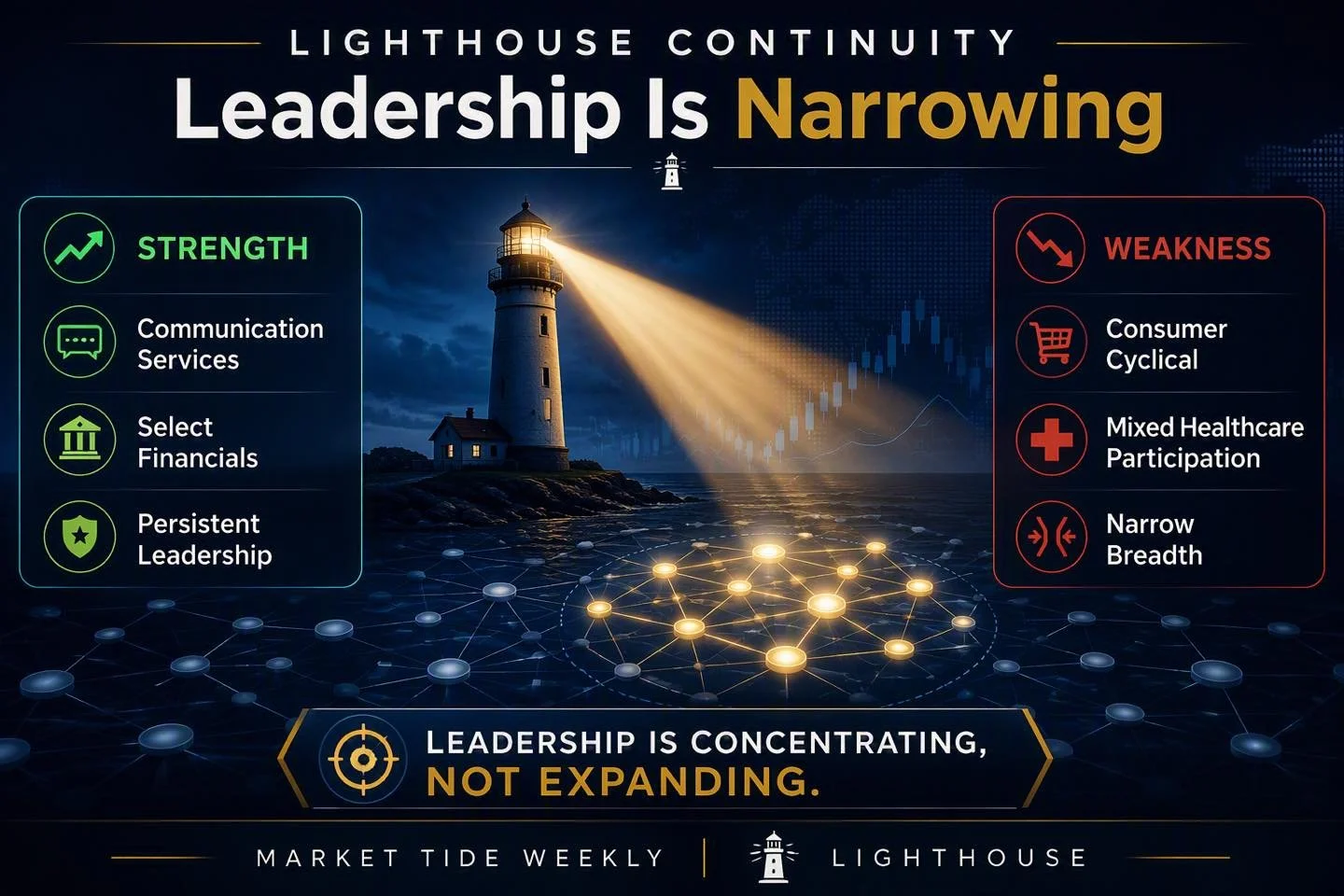
Future FinTech Group Inc. entered the September 2026 Lighthouse sequence as one of the market’s most extreme outliers. On September 14, FTFT closed with a +179.2% Lighthouse reading after reaching a peak reading near +199.1%. The underlying snapshot recorded 21 extreme anomaly observations. Technology’s headline average looked strong, but participation underneath it remained narrow.
That combination matters. An extraordinary move can dominate a sector average without proving that the sector—or the stock—has developed durable leadership. FTFT had earned attention. It had not yet earned confirmation.
The next session supplied the missing information. FTFT’s Lighthouse reading moved to -19.9% on September 15, a deterioration of 199.1 percentage points between the two model markers. On September 16, the reading recovered to +21.9%.
In three sessions, FTFT moved through three distinct states: extreme leader, failed leader, and recovery candidate. That sequence is more informative than any single ranking.
The Filing Record Changes the Interpretation
If FTFT were simply a high-growth company breaking out on improving fundamentals, the volatility could be read through a conventional momentum lens. The filings point to a different setup.
FTFT entered the September sequence after a 100-fold increase in authorized common shares, a 15.06 million-share issuance in September 2025, a transfer of control to Wealth Index Capital Limited, discounted equity-linked financing through Avondale Capital, and an effective resale framework covering up to 20.105 million shares on the pre-2026-split basis.
During 2026, the company completed three separate 1-for-4 reverse splits, registered compensation-plan shares, added another Avondale funding instrument, pursued an AI-themed minority acquisition, and completed a July private placement of 30 million shares at $1.00 per share before the August reverse split.
The latest verified transfer-agent denominator in the collected record is 8,115,223 shares after the August split. WICL and Shanchun Huang reported beneficial ownership of 2,640,625 shares, or 32.5%. That confirms concentration, but it does not establish the effective public float. Restricted private-placement shares, financing-counterparty positions, settlement shares, plan shares, acquisition shares, and other holdings still complicate the supply picture.
None of those filings proves that a specific financing or reverse split caused FTFT’s September move. They do establish that the move occurred inside an unusually fluid capital structure.
The Business Had Not Confirmed the Price
FTFT’s operating record did not provide the kind of confirmation normally associated with durable leadership. FY 2025 revenue was $3.83 million, gross margin fell to 10.66%, continuing operations lost $30.95 million, and operating activities used $31.77 million of cash.
Later quarters showed smaller reported losses and a better mix of gross profit, but the business remained small. Consulting generated much of the gross profit, supply-chain activity produced little or no revenue, and stock-based compensation remained material. Going-concern doubt and ineffective financial-reporting controls also remained unresolved.
The balance sheet looked larger after equity financing, but much of the apparent liquidity sat in acquisition escrow, restricted cash, or receivables whose collection mattered. Accounting working capital was not the same as unrestricted parent-level cash.
That does not make every upside move invalid. It changes the burden of proof. When the operating base is weak and the denominator is unstable, the market must confirm leadership through persistence, breadth, and follow-through—not magnitude alone.
The Public Lesson: Relevance Is Not Leadership
FTFT passed the relevance test. It failed the leadership test.
That distinction is central to the Lighthouse Continuity Engine. A ticker can recur across snapshots and remain important while its directional state deteriorates. A dramatic rebound can restore positive sign without restoring the original leadership condition.
For public readers, the practical framework is straightforward:
· Treat magnitude as an alert, not a conclusion.
· Require next-session sign persistence.
· Look for broader sector participation.
· Check whether the share denominator is stable.
· Separate operating evidence from financing-driven market structure.
The crucial question after a major move is not simply, “Can it go higher?” It is, “Can the signal stop changing state?”
Inside the Subscriber Deep Dive
The full Subscriber Deep Dive goes beyond the three-session chart and reconstructs the filing sequence underneath it. It includes:
· The September 14–16 Lighthouse state-transition timeline
· A normalized review of four reverse splits and the cumulative 1-for-640 adjustment
· The FT Global settlement and staged equity-right structure
· The WICL control transfer and latest verified ownership checkpoint
· The Avondale discounted financing and resale architecture
· The July 2026 $30 million private placement and August share-count reconciliation
· The Changshida acquisition’s unresolved funding and accounting follow-through
· An RCP-III scorecard with RCP-IV escalation triggers
· Bullish, bearish, operating, capital, governance, and Lighthouse confirmation tests
Subscriber conclusion: FTFT was not a meaningless spike. It was a high-value example of how quickly market relevance can appear, fail, and partially recover when business quality, ownership concentration, financing supply, and the share denominator remain unsettled.
Read the full Subscriber Deep Dive for the complete filing timeline, RCP scorecard, and monitoring framework.
Works Cited
Future FinTech Group Inc. “Annual Report for the Fiscal Year Ended 31 December 2024.” Form 10-K, U.S. Securities and Exchange Commission, 15 Apr. 2025. EDGAR.
Future FinTech Group Inc. “Annual Report for the Fiscal Year Ended 31 December 2025.” Form 10-K, U.S. Securities and Exchange Commission, 18 Mar. 2026. EDGAR.
Future FinTech Group Inc. “Current Report: 15.06 Million-Share Issuance and Change of Control.” Form 8-K, U.S. Securities and Exchange Commission, 22 Sept. 2025. EDGAR.
Future FinTech Group Inc. “Current Report: 30 Million-Share Private Placement.” Form 8-K, U.S. Securities and Exchange Commission, 4 Aug. 2026. EDGAR.
Future FinTech Group Inc. “Current Report: Auditor Change.” Form 8-K, U.S. Securities and Exchange Commission, 9 July 2026. EDGAR.
Future FinTech Group Inc. “Current Report: Avondale Pre-Paid Purchase No. 2.” Form 8-K, U.S. Securities and Exchange Commission, 26 Sept. 2025. EDGAR.
Future FinTech Group Inc. “Current Report: Avondale Pre-Paid Purchase No. 3.” Form 8-K, U.S. Securities and Exchange Commission, 26 May 2026. EDGAR.
Future FinTech Group Inc. “Current Report: Fourth Recent 1-for-4 Reverse Stock Split.” Form 8-K, U.S. Securities and Exchange Commission, 26 Aug. 2026. EDGAR.
Future FinTech Group Inc. “Current Report: FT Global Settlement and Forbearance Agreement.” Form 8-K, U.S. Securities and Exchange Commission, 20 June 2025. EDGAR.
Future FinTech Group Inc. “Current Report: Proposed 20 Percent Changshida Acquisition.” Form 8-K, U.S. Securities and Exchange Commission, 15 June 2026. EDGAR.
Future FinTech Group Inc. “Current Report: Second 2026 1-for-4 Reverse Stock Split.” Form 8-K, U.S. Securities and Exchange Commission, 8 July 2026. EDGAR.
Future FinTech Group Inc. “Definitive Proxy Statement for the Special Meeting of Shareholders.” Schedule 14A, U.S. Securities and Exchange Commission, 8 Aug. 2025. EDGAR.
Future FinTech Group Inc. “Quarterly Report for the Quarter Ended 31 March 2025.” Form 10-Q, U.S. Securities and Exchange Commission, 20 May 2025. EDGAR.
Future FinTech Group Inc. “Quarterly Report for the Quarter Ended 30 June 2025.” Form 10-Q, U.S. Securities and Exchange Commission, 19 Aug. 2025. EDGAR.
Future FinTech Group Inc. “Quarterly Report for the Quarter Ended 31 March 2026.” Form 10-Q, U.S. Securities and Exchange Commission, 15 May 2026. EDGAR.
Future FinTech Group Inc. “Quarterly Report for the Quarter Ended 30 June 2026.” Form 10-Q, U.S. Securities and Exchange Commission, 14 Aug. 2026. EDGAR.
Future FinTech Group Inc. “Registration Statement for Resale of up to 20,105,000 Shares of Common Stock.” Form S-1, U.S. Securities and Exchange Commission, 30 Sept. 2025. EDGAR.
Future FinTech Group Inc. “Registration Statement under the 2025 Omnibus Equity Plan.” Form S-8, U.S. Securities and Exchange Commission, 29 May 2026. EDGAR.
Future FinTech Group Inc. “SEC Filings—CIK 1066923.” EDGAR, U.S. Securities and Exchange Commission. Accessed 17 Sept. 2026.
Market Tide Weekly. “Lighthouse Snapshot—14 September 2026.” Lighthouse Continuity Engine, unpublished internal dataset, 14 Sept. 2026.
Market Tide Weekly. “Lighthouse Snapshot—15 September 2026.” Lighthouse Continuity Engine, unpublished internal dataset, 15 Sept. 2026.
Market Tide Weekly. “Lighthouse Snapshot—16 September 2026.” Lighthouse Continuity Engine, unpublished internal dataset, 16 Sept. 2026.
Wealth Index Capital Limited and Shanchun Huang. “Amendment No. 1 to Schedule 13D.” Schedule 13D/A, U.S. Securities and Exchange Commission, 16 Sept. 2026. EDGAR, accession no. 0001213900-26-100660. Accessed 17 Sept. 2026.