KULR Technology Group: Battery Safety Infrastructure — and a Governance Structure Under Stress
🔬 MARKET TIDE DEEP DIVE
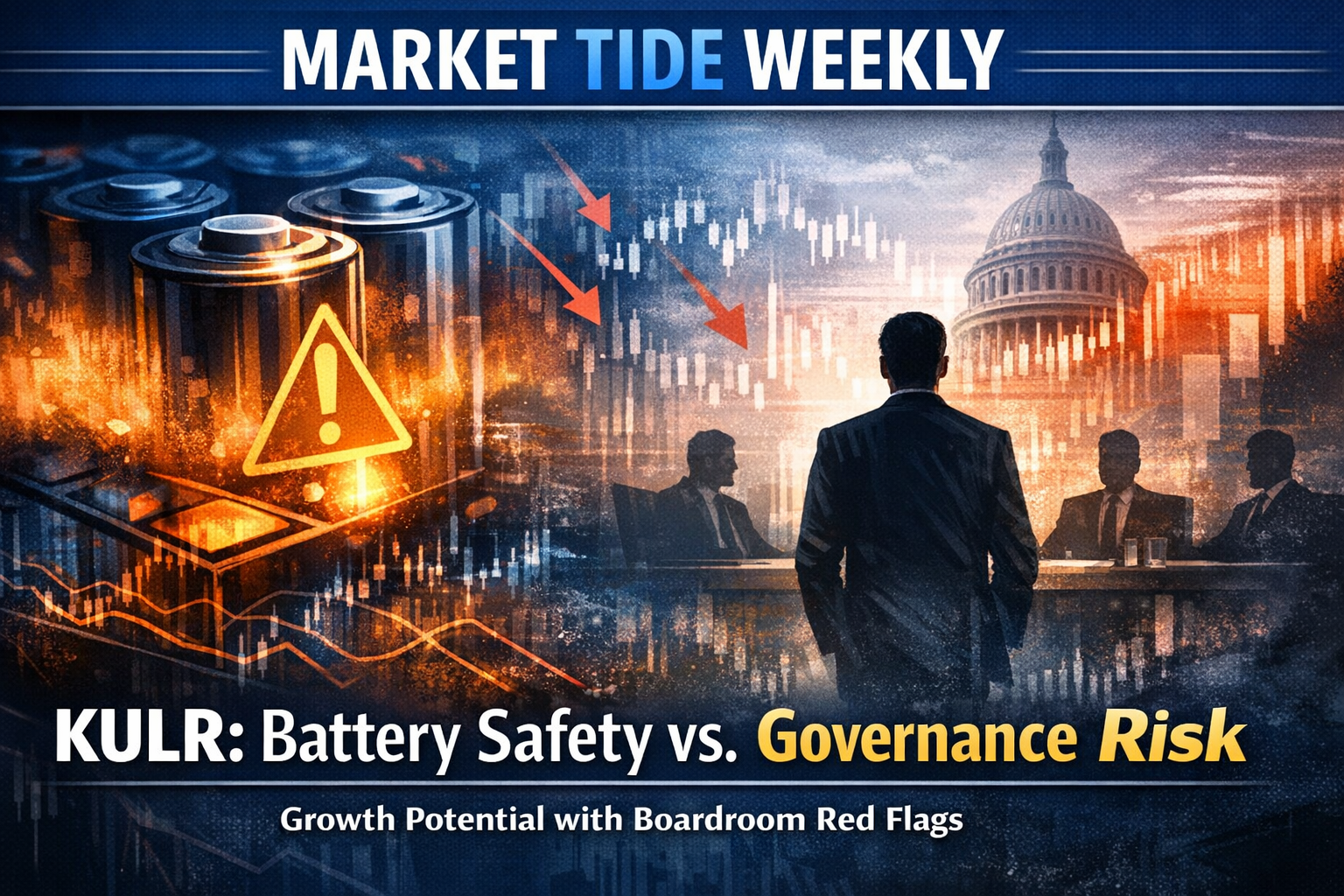
Rewritten with full filings integration 5/23/26. Originally posted as “KULR Technology Group: Battery Safety Opportunity — and Governance Risk Beneath the Surface”
The Setup
KULR Technology Group sits in a strategically important layer of the electrification ecosystem: battery safety, thermal management, and reliability engineering. As lithium‑ion systems proliferate across aerospace, defense, industrial automation, and high‑density energy environments, the cost of failure has become increasingly asymmetric. A single thermal event can compromise missions, platforms, or entire systems.
KULR doesn’t compete on battery scale or production volume. Instead, it positions itself as a safety infrastructure provider — a company whose value is measured not in kilowatt‑hours, but in risk reduction.
But the filings tell a more complicated story.
Across the 10‑K, 10‑Q, and three 8‑Ks filed between March and May 2026, KULR is not simply navigating operational growth. It is undergoing a structural shift in governance, financial exposure, and control.
The core question becomes:
👉 Can a company with accelerating operational signals scale under a governance model that is increasingly centralized and structurally fragile?
The Filing Evidence
1. The 10‑K: Legacy Identity vs. Emerging Structure
The 2025 10‑K reinforces KULR’s traditional identity:
Thermal interface materials
Battery safety testing
Aerospace and defense customers
Mission‑critical reliability work
This is the KULR most investors think they’re buying.
But the 10‑K also introduces the first signs of structural drift:
Digital asset mining is a formal operating segment
Customer and supplier concentration risk is high
Multiple financing mechanisms are active (ATM offerings, promissory notes, loan agreements)
The filings show a company with two identities: one in battery safety, and one in crypto‑adjacent financial engineering.
2. The 10‑Q: Operational Progress — and a Crypto Shock
The Q1 2026 10‑Q shows real operational movement:
Revenue doubled YoY
Gross profit improved
Inventory and equipment deposits increased
Project activity appears to be rising
But the financial structure tells a different story:
$65.3M in digital assets
$8.5M pledged as collateral
$20.7M fair‑value loss on digital assets in Q1
Net loss of $28.1M
R&D declined from $2.45M → $1.77M
This is not a pure engineering company. This is a company whose financial outcomes are dominated by crypto volatility, not battery safety.
3. The 8‑Ks: A Three‑Stage Governance and Narrative Pivot
Across March 31 → April 28 → May 14, the filings reveal a structural inflection point.
March 31, 2026 — FY2025 Results (Old Board)
A standard earnings release. Normal cadence. No governance signals.
April 28, 2026 — Governance Purge (Control Event)
This is the filing that changes everything.
Four directors removed
Board reduced from six to three
Lead Independent Director eliminated
Committees now run by two individuals
Full bylaw rewrite executed immediately
Action taken via written consent
Enabled by CEO’s ~70% voting control
This was not a governance “optimization.” It was a control consolidation.
May 14, 2026 — Q1 2026 Results (New Narrative Era)
Two weeks after the purge, KULR issues Q1 results and explicitly states that:
The company uses its website and social media channels (including Facebook) to disseminate material information.
This is a narrative reset, not just an earnings release.
The Opportunity
Despite the structural complexity, the opportunity is real.
Battery safety is becoming a non‑negotiable requirement in:
Spaceflight systems
Defense platforms
High‑density industrial environments
Electrified transportation
Energy storage infrastructure
KULR’s technology is directly relevant to these environments, where:
Failure costs are high
Reliability is mission‑critical
Safety is a procurement driver
If KULR transitions from project‑based engineering to embedded system adoption or certification frameworks, the company could evolve into a scalable safety infrastructure provider.
This is the upside scenario.
The Risks
The filings reveal risks that are structural, not cyclical.
1. Governance Concentration
CEO holds ~70% voting control
Board reduced to three members
Full bylaw rewrite
Committees run by two individuals
This is a governance model built for speed, not oversight.
2. Financial Structure
Crypto exposure dominates the balance sheet
Fair‑value losses drive net results
R&D investment is declining
Multiple financing mechanisms signal liquidity pressure
3. Scaling Uncertainty
Revenue is still project‑based
Customer concentration risk persists
No evidence yet of embedded system adoption
4. Narrative vs. Structure Divergence
Public messaging emphasizes engineering and safety
Filings reveal crypto exposure and governance centralization
Social media is now a material disclosure channel
This divergence is a risk in itself.
MTW Bottom Line
KULR remains one of the more intriguing second‑order electrification plays — a company positioned not on battery volume, but on battery safety, thermal stability, and mission‑critical reliability.
But the filings reveal a company in transition:
Operational momentum is real
Governance is consolidating
Financial exposure is shifting
Narrative channels are expanding
Oversight capacity is shrinking
👉 Execution is accelerating at the same moment governance is centralizing.
That combination creates tension.
If KULR can convert its engineering progress into embedded system adoption, its relevance could increase materially. But investors must weigh that upside against a governance structure that concentrates decision‑making and reduces independent oversight — all while the company carries significant crypto exposure on its balance sheet.
This is a company with real opportunity — and real structural risk.
1️⃣ Hidden Business Exposure table
| Narrative Claim | Filings Evidence | Structural Implication |
|---|---|---|
| KULR is a battery safety company. | 10‑Q shows $65.3M digital assets + $8.5M pledged as collateral. | KULR is financially crypto‑exposed, not purely battery‑focused. |
| Innovation‑driven engineering company. | R&D declined from $2.45M → $1.77M. | Innovation messaging is aspirational; investment is shrinking. |
| Scaling through engineering. | Multiple financing agreements (ATM, promissory notes, loans). | Liquidity management is a major operational priority. |
2️⃣ Narrative cadence vs. filings cadence table
| Narrative Claim | Filings Evidence | Structural Implication |
|---|---|---|
| Company is communicating progress. | Three 8‑Ks in 45 days: FY results → governance purge → Q1 results. | This is a narrative pivot sequence. |
| Social media is part of investor engagement. | Apr 28 8‑K explicitly states social channels may contain material information. | Facebook messaging is strategic IR, not marketing fluff. |
| Execution is accelerating. | Q1 10‑Q shows revenue growth and operational movement. | True — but overshadowed by governance and crypto volatility. |
3️⃣ Governance & control table
| Narrative Claim | Filings Evidence | Structural Implication |
|---|---|---|
| Company is optimizing governance for efficiency. | Apr 28 8‑K: CEO used ~70% voting control to remove 4 directors and rewrite bylaws. | Governance is centralized, not optimized. |
| Board restructuring for cost savings. | Board reduced from 6 → 3; committees now run by 2 people. | Oversight capacity materially reduced. |
| Normal governance evolution. | Full bylaw rewrite executed same day. | This was a control event, not routine governance. |
4️⃣ Financial structure table
| Narrative Claim | Filings Evidence | Structural Implication |
|---|---|---|
| Business is progressing. | Q1 net loss: $28.1M, driven by $20.7M crypto fair‑value loss. | Crypto volatility dominates financial outcomes. |
| Company is scaling. | Revenue still project‑based; customer concentration risk persists. | Scaling is not yet durable or recurring. |
| Company is stable. | Accumulated deficit: $173.8M. | Long‑term financial pressure remains. |
5️⃣ Opportunity vs. risk table
| Opportunity Narrative | Filings Reality | Implication |
|---|---|---|
| Battery safety is a critical bottleneck in electrification. | True — filings confirm mission‑critical applications. | Strong thematic tailwind. |
| KULR could transition from project‑based to embedded systems. | No filings contradict this — but no evidence of transition yet. | Upside scenario remains speculative. |
| Execution is improving. | Revenue up, gross profit up. | Execution is real. |
| Governance is a risk. | Governance is the risk — centralized control, reduced oversight, bylaw rewrite. | Governance risk is structural, not temporary. |