Reverse-Cycle Predators: The Small-Cap Filing Pattern Behind ZCMD, KIDZ, and LUCY
MARKET TIDE WEEKLY - TUESDAY EDITION: July 7, 2026
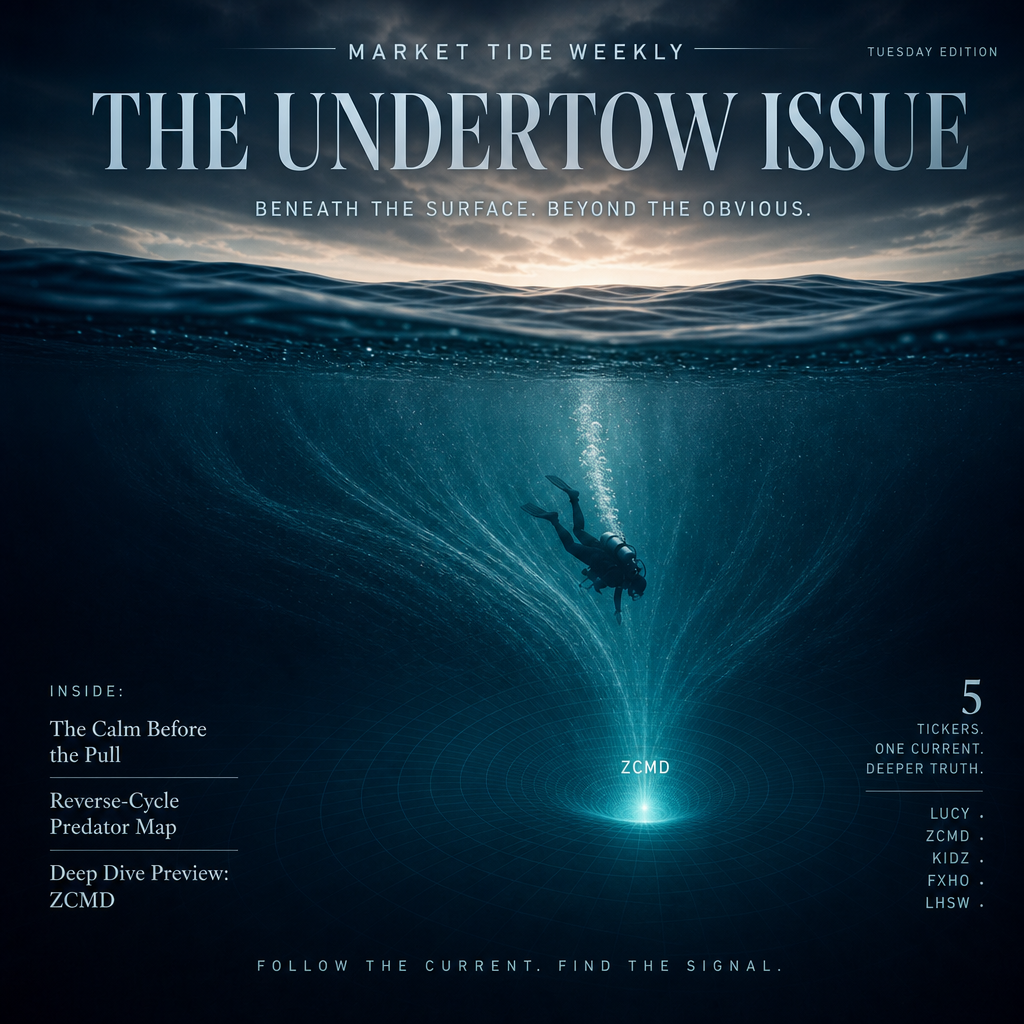
Beneath the surface, the current never sleeps. The 2026 Undertow motif anchors this week’s edition — tracing how structural weakness becomes capacity, and how capacity resets.
A calm Lighthouse surface hid a reverse-current pull beneath the map — and ZCMD dragged this week’s scan into the deeper machinery of reverse splits, offerings, warrants, and governance resets.
The tide held perfectly still across every Lighthouse sweep — six snapshots yesterday, one this morning, 11,400 names each time, zero drift, zero sector changes, zero country changes. A surface so calm it felt unnatural. Beneath that stillness, the engine flagged a massive fundamental blackout and a sector-weight freeze dominated by Financials, locking the map into a heavy stillness.
And in that stillness, one name began pulling the entire tide downward: ZCMD.
That undertow forced us below the surface — past the obvious filings and into deeper, murkier chambers where the structural motion became impossible to ignore. This week’s Tuesday Edition brings the scan back above water as a Reverse-Cycle Predator map across five names: LUCY, ZCMD, KIDZ, FXHO, and LHSW. The public version focuses on three: LUCY, ZCMD, and KIDZ. The two additional names remain reserved for email subscribers.
What Is a Reverse-Cycle Predator?
At Market Tide Weekly, a Reverse-Cycle Predator, or RCP, is a company whose filings show a repeated loop of weak operations, listing pressure, reverse splits, dilutive financing, warrant overhang, and governance resets — where the capital structure becomes more important than the operating business.
The danger is not simply that a stock has gone through a reverse split. Reverse splits can be legitimate tools. The danger appears when the filings show the same cycle repeating: weak operations lead to financing, financing creates dilution and pressure, pressure leads to a reverse split, and the reset becomes the setup for the next financing round.
In those cases, the chart may look new, but the business may not have changed. The filing sequence tells the truth before the chart does.
Why This Week Matters
This week’s filing stack is not a clean growth screen. It is a survival-structure screen. Across the slate, the filings show companies using capital-market tools — offerings, warrants, equity facilities, convertible notes, reverse-split authority, and charter changes — to preserve flexibility while operating fundamentals remain uncertain.
That matters because reverse splits can create optical resets. A lower share count, a new post-split price, or a cleaner-looking chart does not repair weak revenue, cash burn, liquidity pressure, warrant overhang, convertible exposure, or governance risk. In RCP situations, the sequence is the signal.
This week’s public slate gives us three versions of that signal: LUCY as the constructive contrast, ZCMD as the pure RCP case, and KIDZ as the capital-structure machine.
The Public Slate
LUCY — The Constructive Contrast
Innovative Eyewear is still capital-dependent, but it is not the same kind of case as the deeper RCP names in this batch. The filing stack shows recurring losses, going-concern pressure, and repeated common-stock-and-warrant financing, but the January 2026 sales update adds a real operating hook.
The company reported approximately $1 million in Q4 2025 sales, up 45% year over year, and approximately $2.7 million in full-year 2025 sales, up 65% from 2024. It also pointed to Lucyd Armor smart safety eyewear and Reebok sport smart eyewear as growth drivers, claimed approximately 44% Amazon market share in smart safety glasses, and said senior leaders intended to buy shares subject to securities-law and insider-trading-policy constraints. (Innovative Eyewear, Exhibit 99.1, Jan. 2026)
The risk is that the operating signal may not outrun dilution. LUCY still needs to prove repeatable channel growth, sustainable margins, disciplined financing, and actual insider-buying follow-through through future filings.
ZCMD — The Pure Reverse-Cycle Predator Case
Zhongchao is the cleanest RCP case in the public slate. Its filings show weak operating results giving way to governance flexibility, offering registration, warrant-linked financing, ownership movement, and two 2026 reverse share consolidations.
The sequence matters. The September 2025 Form 6-K establishes the pre-cycle baseline: declining revenue, net losses, liquidity pressure, and no reverse-split or offering language. The January 2026 20-F/A clarifies Cayman home-country governance reliance under Nasdaq foreign private issuer rules. The March confidential registration statement begins the offering pathway. The May F-1, F-1/A, and EFFECT notice turn that pathway into a public registration sequence. The June offering documents, bridge filing, Schedule 13G, second reverse split, and amended memorandum complete the machinery. (Zhongchao, 6-K, Sept. 2025; Zhongchao, 20-F/A, Jan. 2026; Zhongchao, F-1/A, May 2026; Zhongchao, 424B4, June 2026)
This is why ZCMD is Thursday’s Deep Dive subject. Tuesday shows the map. Thursday follows the machine: the offering trail, the reverse-split sequence, the governance machinery, and the continuity breaks that turned a routine filing review into something darker beneath the tide.
KIDZ — The Capital-Structure Machine
Classover is not identical to ZCMD, but it belongs in the same edition because its filings show how financing capacity can become the central story before an operating turnaround is proven.
The April 2026 Form 10-K establishes a stressed baseline: shrinking revenue, high operating costs, financing dependence, crypto-linked balance-sheet volatility, a working-capital deficit, and going-concern pressure. The May 2026 Form 10-Q then confirms the pattern in Q1: revenue down 36% year over year to $519,198, operating expenses up 65% to $1,155,713, operating loss of $894,815, and net loss widening to $4,187,534. (Classover Holdings, 10-K, Apr. 2026; Classover Holdings, 10-Q, May 2026)
From there, the filing stack becomes a capital-structure buildout: reverse-split authority, expanded Class B share capacity, an ATM Sales Agreement, a ChEF equity facility, a Senior Secured Convertible Note, resale-registration mechanics, rights modifications, and shelf-takedown activity. The risk is that these tools support survival without proving recovery. If future filings show revenue quality, lower operating losses, and reduced dependence on structured financing, KIDZ can become a high-risk reset story. If not, the financing architecture may become the story itself.
The RCP Map
LUCY, ZCMD, and KIDZ form the week’s public RCP spectrum. LUCY is the operating-traction exception. ZCMD is the clean structural predator. KIDZ is the dilution-capacity case study.
Reverse-Cycle Predator Map — Public Slate
Reverse-Cycle Predator Map — Public Slate
| Company | Operating Signal | Financing Signal | Share-Structure Signal | Primary Risk |
|---|---|---|---|---|
| LUCY | Preliminary 2025 sales growth and smart-safety-eyewear traction. | Repeated common-stock and warrant financing. | Dilution risk, but no central reverse-split signal in this slate. | Operating traction may not outrun financing pressure. |
| ZCMD | Weak operating baseline with limited recovery evidence. | Offering registration, best-efforts financing, warrants, and post-offering ownership movement. | Two 2026 reverse share consolidations, including the June 8 1-for-31 consolidation. | Capital-structure engineering may be preserving listing access while shareholders absorb dilution and post-split pressure. |
| KIDZ | Weak financials, revenue decline, widened net loss, and going-concern pressure. | ATM program, ChEF equity facility, secured convertible note, resale registration, and shelf-takedown activity. | Reverse-split authority, expanded Class B share capacity, and charter execution. | Financing capacity may become the business story unless operations improve. |
What We’re Watching Next
· Whether LUCY follows its sales-growth release with confirmed Form 4 insider purchases and continued channel traction.
· Whether ZCMD files any post-split operating update that interrupts the RCP pattern, or whether additional governance, warrant, or offering documents extend it.
· Whether KIDZ shows operating progress after its April-to-July capital-structure reset, especially revenue quality, cash usage, note-conversion activity, ATM usage, ChEF draws, and authorized-share implementation.
Thursday Preview: ZCMD Goes Below the Surface
Thursday’s Deep Dive will focus entirely on ZCMD’s Reverse-Cycle Predator sequence. The investigation follows the September 2025 financial baseline, January 2026 governance amendment, March confidential registration statement, May F-1 / F-1A / EFFECT sequence, June 424B4 offering, June 5 bridge filing, Schedule 13G ownership disclosure, June 8 1-for-31 consolidation, and June 23 amended memorandum.
For now, Tuesday gives you the map. Thursday follows the machine.
Get the Full Edition
The public map covers LUCY, ZCMD, and KIDZ. Email subscribers receive the two additional names in this week’s structural scan — FXHO/WTO and LHSW — along with the full Thursday ZCMD Deep Dive when we follow the undertow all the way down.
Share this week’s edition with someone who follows small-cap filings, market structure, or the warning signals that appear before a chart explains them.
Disclosure
Market Tide Weekly is for informational and educational purposes only. Nothing in this newsletter constitutes investment advice, a solicitation to buy or sell any security, or a guarantee of any outcome. Past performance of featured picks is not indicative of future results. All investing involves risk, including the possible loss of principal. Readers should conduct their own due diligence and consult a qualified financial advisor before making investment decisions. Market Tide Weekly and its operators may hold positions in securities discussed.