Recovery With Receipts: Three Filing-Backed Setups for the Tuesday Edition
MARKET TIDE WEEKLY TUESDAY EDITION - August 4, 2026
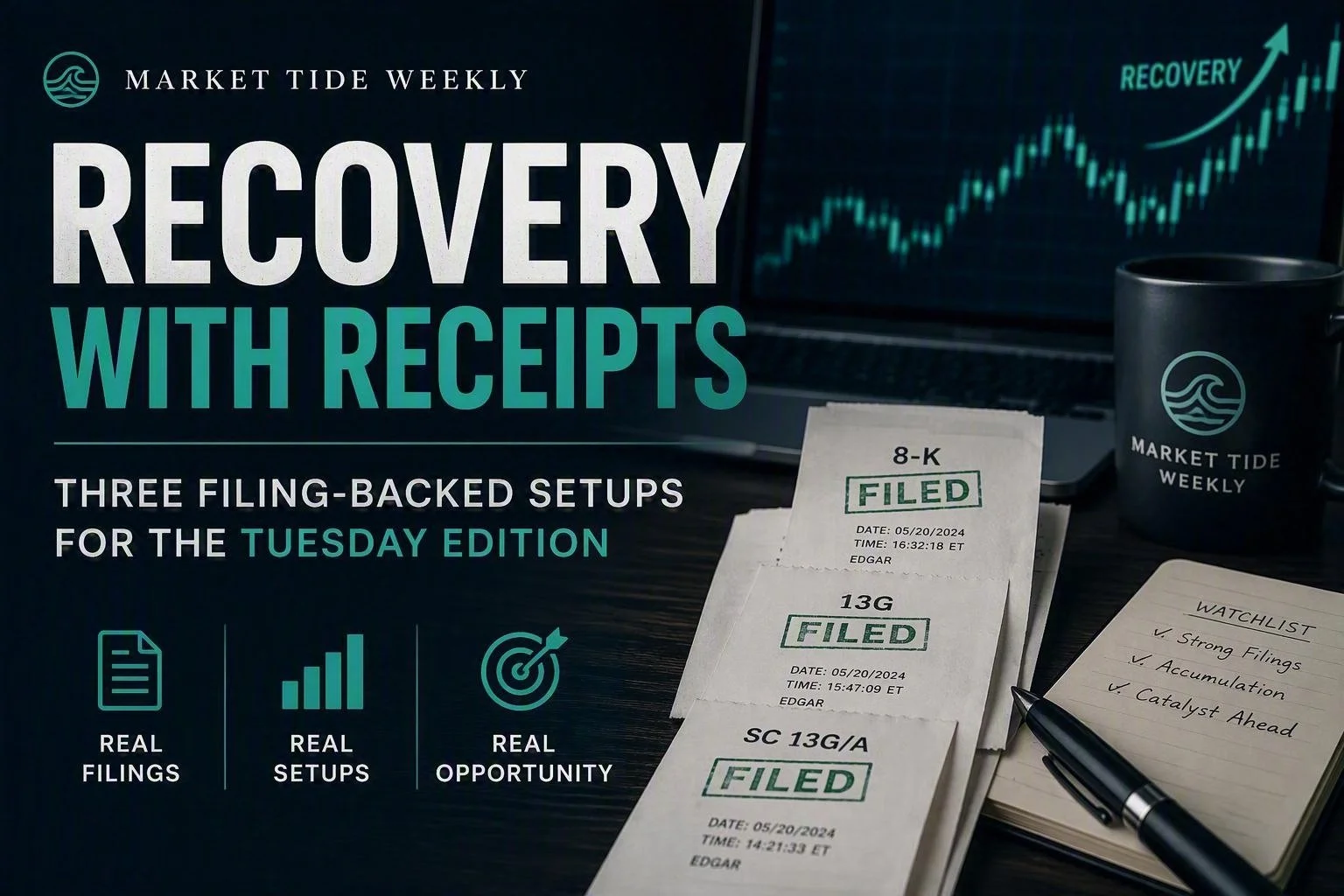
Recovery With Receipts: Three Filing-Backed Setups for the Tuesday Edition — Market Tide Weekly
Reader Mode Summary: This week’s public edition focuses on three companies where the filings show a business moving from uncertainty toward a clearer operating phase. VYX is the transformation case, with platform adoption, recurring revenue, and contract value replacing an older hardware-heavy story. IMMR is the credibility recovery case, where a BNED-related reporting crisis moved through restatement, Nasdaq pressure, delayed filings, compliance restoration, and a new post-crisis baseline. TASK is the public-market accountability case, where shareholders rejected a take-private transaction and management then had to prove the independent company still had a stronger path forward.
Market Spine: Selectivity, Not Euphoria
The market does not need another broad argument about momentum this week. It needs a filter. Smaller and mid-sized names can move quickly when investors begin separating real continuity from noise, but the better setup is not always the cleanest chart or the fastest headline grower. Sometimes it is the company whose filing trail has started to show that a difficult transition is becoming measurable.
That is the spine of this Tuesday Edition: recovery with receipts. The receipts matter. They are the filings, the sequence of disclosures, the governance updates, the quarterly reports, the transaction documents, and the compliance notices that show whether management has actually crossed a rough channel or is merely promising land on the horizon.
The Pick Unifier: Three Versions of Recovery
VYX, IMMR, and TASK are not the same kind of story. That is the point. VYX is trying to prove that a simplified commerce platform can grow recurring revenue and turn transformation work into durable economics. IMMR is trying to prove that the BNED reporting crisis has moved from open wound to closed chapter. TASK is trying to prove that the failed take-private process did not weaken the company’s public-market case.
Together, they form a useful public slate because the argument is not hype. It is progression. Each name has a before-and-after structure in the filings. Each one has a risk that remains visible. Each one offers enough public evidence to discuss without pretending the work is finished.
VYX: The Clean Transformation Case
VYX gives this edition its cleanest transformation arc. The company has spent the recent filing cycle simplifying the business, reducing hardware dependence, selling non-core operations, and repositioning around software, services, payments, and platform economics for retail and restaurant customers.
The important point is not that reported revenue has already become a clean growth story. It has not. The stronger point is that the business is easier to evaluate after the company moved away from a more hardware-heavy structure. The Q1 2026 filing sequence showed recurring revenue growth, recurring software revenue growth, expanding platform sites, more payment sites, and a sharp increase in Remaining Contract Value. That is the evidence trail MTW cares about.
The risk is also clear. Transformation stories can look better before they become durable growth stories. VYX still has to convert platform adoption and contracted demand into sustained software-led revenue growth. If recurring revenue weakens, if Remaining Contract Value fails to convert, or if the completed hardware transition does not deliver the expected margin and cash-flow benefits, the thesis becomes less attractive. For now, VYX earns its place because the filings show progress that is specific, measurable, and still early enough to matter.
IMMR: The Credibility Recovery Case
IMMR is not the cleanest story in the public slate. It is the credibility recovery story. The filing chain moved through a BNED-related accounting investigation, delayed reports, non-reliance language, expected restatements, Nasdaq deficiency notices, a Staff Determination Letter, a hearing process, delayed quarterly filings, and then eventual restoration of Nasdaq compliance.
That sequence is too serious to flatten into a simple turnaround slogan. The point is that the crisis was visible, documented, and then moved through a remediation path. Management completed the delayed annual filing, worked through the quarterly backlog, regained Nasdaq compliance, and filed a FY2026 annual report that now serves as the post-crisis baseline. At the same time, the company maintained and increased its dividend, preserved a capital-allocation message, and moved back toward ordinary governance activity.
The risk is obvious: restored compliance is not the same as a permanently repaired business. IMMR still has to prove that BNED integration, legacy licensing revenue, internal controls, and capital allocation can coexist without creating another reporting setback. But the filings now show an arc that was not visible at the low point of the crisis: investigation, restatement, backlog clearance, Nasdaq restoration, and a new annual baseline. That is why IMMR belongs in this week’s public edition.
TASK: The Public-Market Accountability Case
TASK carries the strongest narrative energy. The company tried to go private. Unaffiliated shareholders rejected the deal by a wide margin. The merger agreement was terminated without a breakup fee. Then management had to answer the public market the hard way: by continuing to operate, refinancing the balance sheet, paying a large special dividend, preserving liquidity, pushing AI Services growth, and completing CFO succession.
The vote matters because it changes the story. This was not merely a management-led transaction that failed on technical grounds. The public-shareholder vote showed that the required unaffiliated support was not there. That made TASK an accountability test. If shareholders were right to reject the $16.50 offer, the company now has to prove that the independent public-company path can create more value than the rejected exit.
The filings since the failed transaction provide both sides. The positive side is clear: Q3 2025 operating results remained strong after the transaction process, the refinancing closed, the special dividend was paid, AI Services continued growing quickly, and permanent finance leadership was installed. The caution side is also clear: the recapitalization left the company with more leverage, lower equity, margin pressure, and guidance that pointed to slower consolidated growth. That tension makes TASK the strongest candidate for Thursday’s Deep Dive.
Subscriber Layer
The subscriber edition extends this same recovery-with-evidence framework into two additional names: HCKT and MEI. Those setups stay below the public waterline because they need more room for nuance, risk framing, and valuation context than the public article should force into a short read. Public readers get the three-name filing walk. Subscriber readers get the full five-name slate.
Thursday Deep Dive Preview
TASK is the early Deep Dive leader because the question is clean: did public shareholders reject an inadequate exit, or did they force themselves to keep owning a more leveraged company with slower near-term growth? The filings give both sides of that argument. That is the kind of tension a Deep Dive should carry.
For Thursday, the likely angle is not “TASK was right” or “TASK was wrong.” The better angle is whether the public market now has enough proof to judge the shareholder vote. The company’s AI Services growth, refinancing execution, special dividend, and CFO appointment keep the upside case alive. The leverage increase, margin pressure, and slower guidance keep the risk case alive. That unresolved balance is the story.
For the public article, VYX should be positioned as the “clean transformation” pick. The important point is not that reported revenue is already accelerating. It is that the business model is easier to understand after the company moved away from non-core operations and toward a software-, services-, payments-, and platform-centered structure. The latest 10-Q language around recurring revenue, recurring software revenue, platform sites, payment sites, and Remaining Contract Value gives the article a concrete way to discuss progress without overstating the case. The risk paragraph should be equally clear: transformation stories can look cleaner before they become growth stories, and VYX still has to convert adoption and contract value into durable software-led revenue expansion.
Visual Anchor
Cover concept: Three Public Currents, Two Subscriber Depths. Use a dark ocean surface with three illuminated markers above the waterline: VYX — Transformation, IMMR — Recovery, TASK — Independence. Beneath the surface, show two softer submerged markers labeled HCKT and MEI under “Subscriber Depth.” The visual should feel like navigation through a difficult market channel, not stock hype.
Square social version: A simplified square graphic with three bright ticker markers above the waterline and two dimmer subscriber markers below it. Caption: “Three public setups. Two deeper subscriber reads. This week’s theme: recovery with receipts.”
CTA
This public edition gives you the surface current: VYX, IMMR, and TASK. The subscriber edition goes below the waterline with the full five-name slate, including HCKT and MEI. If this week’s theme is recovery with receipts, the subscriber version is where the deeper receipts live.
Disclosure: Market Tide Weekly is for informational and educational purposes only and is not financial advice, investment advice, or a recommendation to buy or sell any security. Readers should conduct their own research and consider their own risk tolerance before making investment decisions. Forward-looking statements, business outlooks, and company projections are subject to change. Confirm current filings, prices, and disclosures before acting.
Works Cited
Immersion Corporation. Form 8-K: Non-Reliance on Previously Issued Financial Statements or a Related Audit Report or Completed Interim Review. U.S. Securities and Exchange Commission, 8 Sept. 2025.
Immersion Corporation. Form 8-K: Notice of Delisting or Failure to Satisfy a Continued Listing Rule or Standard. U.S. Securities and Exchange Commission, 13 Feb. 2026.
Immersion Corporation. Form 8-K: Nasdaq Compliance Restored. U.S. Securities and Exchange Commission, 15 May 2026.
Immersion Corporation. Form 10-K for the Fiscal Year Ended April 30, 2026. U.S. Securities and Exchange Commission, 24 July 2026.
Immersion Corporation. Form 8-K: Fiscal 2026 Results and Management Commentary. U.S. Securities and Exchange Commission, 27 July 2026.
NCR Voyix Corporation. Form 10-K for the Fiscal Year Ended December 31, 2025. U.S. Securities and Exchange Commission, 26 Feb. 2026.
NCR Voyix Corporation. Form 10-Q for the Quarter Ended March 31, 2026. U.S. Securities and Exchange Commission, 7 May 2026.
TaskUs, Inc. Form 8-K: Special Meeting Voting Results. U.S. Securities and Exchange Commission, 8 Oct. 2025.
TaskUs, Inc. Form 8-K: Termination of Merger Agreement. U.S. Securities and Exchange Commission, 9 Oct. 2025.
TaskUs, Inc. Form 8-K: Refinancing Commitment and Special Cash Dividend. U.S. Securities and Exchange Commission, 25 Feb. 2026.
TaskUs, Inc. Form 8-K: New Credit Facilities and Refinancing Completion. U.S. Securities and Exchange Commission, 17 Mar. 2026.
TaskUs, Inc. Form 10-Q for the Quarter Ended March 31, 2026. U.S. Securities and Exchange Commission, 7 May 2026.
TaskUs, Inc. Form 8-K: Appointment of Chief Financial Officer. U.S. Securities and Exchange Commission, 22 June 2026.
SEO tags: Market Tide Weekly, Tuesday Edition, VYX, NCR Voyix, IMMR, Immersion Corporation, TASK, TaskUs, HCKT, MEI, SEC filings, small cap stocks, public market accountability, Nasdaq compliance, AI services, recurring revenue, special dividend, shareholder vote, filing analysis, recovery stocks