TaskUs Survived a Failed Take-Private Deal. Now AI Services Must Carry the Next Chapter.
A rejected $16.50 take-private offer left TaskUs public, growing, and more leveraged. AI Services are gaining momentum, but the company's next chapter will depend on whether growth and cash generation can justify a more demanding balance sheet.
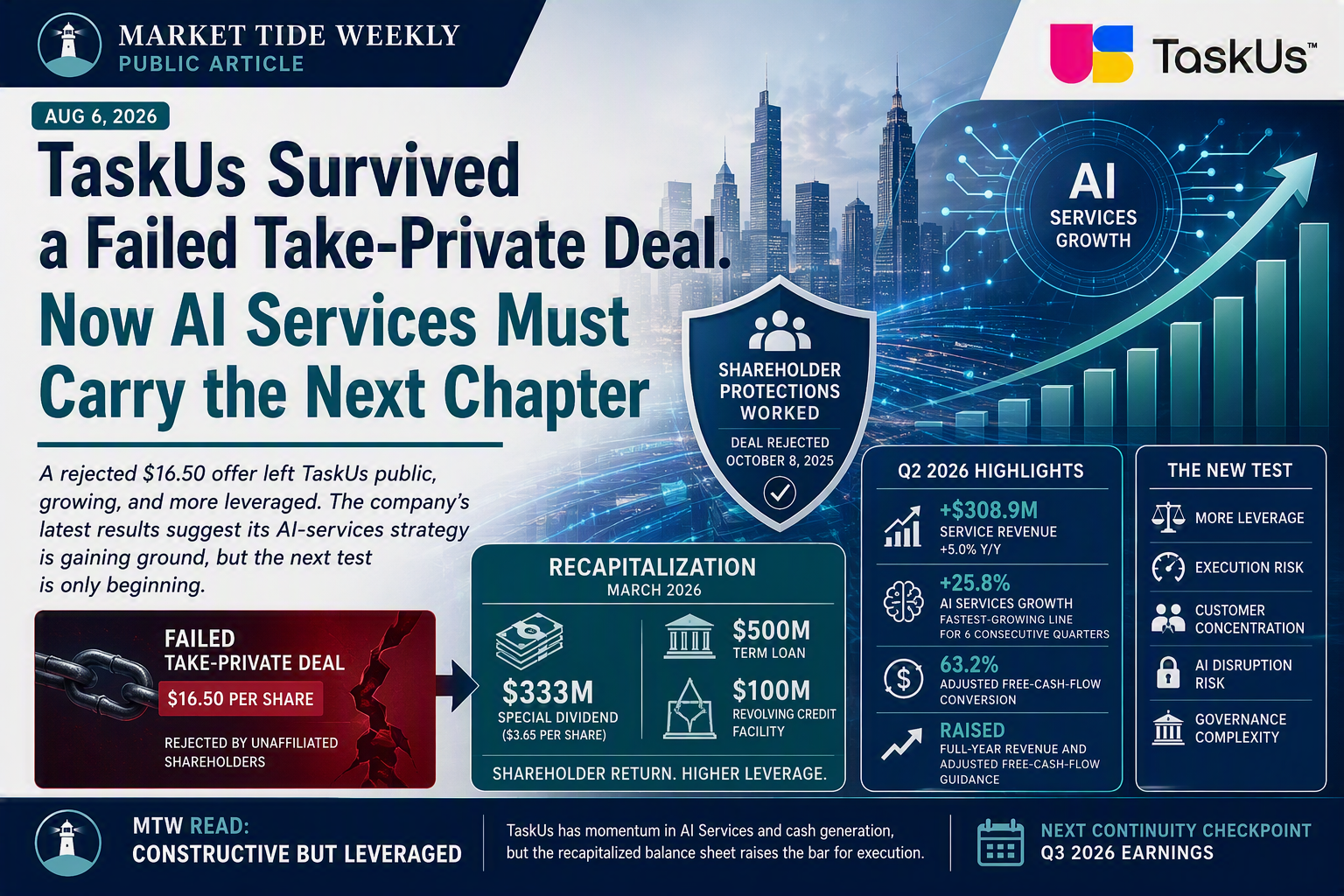
A rejected $16.50 offer left TaskUs public, growing, and more leveraged. The company’s latest results suggest its AI-services strategy is gaining ground, but the next test is only beginning.
TaskUs spent much of 2025 caught between two competing futures.
In one, the company would disappear from the public market through a founder- and sponsor-backed take-private transaction valued at $16.50 per share. In the other, TaskUs would remain public and attempt to prove that its growing AI-services business, durable cash generation, and operational execution could create a stronger path for shareholders.
Public shareholders chose the second future.
After two adjournments failed to produce the required support from unaffiliated shareholders, the proposed merger was rejected on October 8, 2025. TaskUs and Breeze Merger Corporation terminated the agreement the following day without a termination fee. (TaskUs, Form 8-K, 8 Oct. 2025; TaskUs, Form 8-K, 9 Oct. 2025)
The rejection did not end the company’s shareholder-value debate. It simply moved the debate from the voting booth back to the operating results.
A Stronger Business During a Failed Deal
The take-private process unfolded while TaskUs was reporting some of its strongest recent growth.
Revenue increased approximately 22% year over year in the first quarter of 2025. Second-quarter service revenue grew 23.6%, with all three service lines delivering double-digit growth. Third-quarter service revenue still increased 17%, while net income more than doubled from the prior-year period. (TaskUs, Form 10-Q, 12 May 2025; TaskUs, Form 10-Q, 7 Aug. 2025; TaskUs, Form 10-Q, 7 Nov. 2025)
Those results created an unusual collision. The company was asking public shareholders to approve a $16.50-per-share exit while the business was expanding, earnings were improving, and AI Services was emerging as its fastest-growing service line.
That does not prove the proposed price was inadequate. The filings establish that the transaction failed to secure the required approval, but they do not establish the reason each shareholder voted against it. Any definitive judgment regarding transaction fairness, valuation, projections, or the Special Committee’s analysis must remain tied to the merger proxy and Schedule 13E-3 materials. (TaskUs, Definitive Merger Proxy; TaskUs, Schedule 13E-3/A, 8 Aug. 2025)
What the record does show is that the shareholder protection mattered. The transaction could not proceed without approval from unaffiliated holders, and those holders exercised an effective veto.
Management Chose a Different Path
Once the deal failed, TaskUs did not immediately return with another take-private proposal.
Instead, management kept the company public, refinanced its credit structure, paid a $3.65-per-share special dividend, and continued investing in AI-enabled services. The dividend represented approximately $333 million in aggregate distributions. The new financing included a $500 million term loan and a $100 million revolving credit facility. (TaskUs, Form 8-K, 25 Feb. 2026; TaskUs, Form 8-K, 17 Mar. 2026)
That decision returned substantial capital to shareholders, but it also changed the company’s risk profile.
TaskUs entered the recapitalization with an operating story built around AI Services, Trust & Safety, digital customer experience, data operations, content moderation, and human support for increasingly automated systems. It emerged with that strategic story intact, but with higher debt, lower shareholders’ equity, and less room for operating disappointment.
The question facing shareholders therefore changed.
Before the failed transaction, investors had to decide whether $16.50 fairly represented the value of TaskUs’s future. After the recapitalization, they must decide whether the public company can generate enough growth and cash flow to justify the added leverage.
The AI Opportunity Is Becoming More Concrete
TaskUs is not an artificial-intelligence model developer. Its opportunity sits in the operational layer surrounding AI deployment.
The company’s filings and earnings materials point to work involving AI model training and maintenance, AI safety, Trust & Safety, content moderation, data operations, robotics, autonomous-vehicle support, and human oversight of automated systems. That places TaskUs in a second-order AI category: it may benefit not by building the models, but by helping clients train, monitor, govern, and operationalize them. (TaskUs, Form 10-K, 5 Mar. 2026; TaskUs, Form 8-K, 5 Aug. 2026)
The latest operating evidence supports that framing.
In the first quarter of 2026, TaskUs reported service-revenue growth of 10.3% and AI Services growth of 36.1%. Adjusted free-cash-flow conversion also improved substantially, although adjusted profitability and margins weakened. (TaskUs, Form 8-K, 6 May 2026; TaskUs, Form 10-Q, 7 May 2026)
The second quarter added another positive checkpoint. Service revenue reached $308.9 million, increasing 5.0% year over year. AI Services grew 25.8% and remained the company’s fastest-growing service line for a sixth consecutive quarter. Adjusted free-cash-flow conversion reached 63.2%, and management raised its full-year revenue and adjusted free-cash-flow guidance. (TaskUs, Form 8-K, 5 Aug. 2026)
The company is no longer trying to prove that AI Services exist as a meaningful growth category. Its next challenge is proving that the category can remain strong enough to offset slower growth elsewhere.
AI Is Also the Disruption Risk
The central tension is that AI can expand and compress TaskUs’s opportunity at the same time.
Greater AI adoption can create demand for training data, model maintenance, safety controls, content review, governance, and human intervention. It can also automate portions of the customer-support and outsourced digital work that companies previously assigned to human teams.
TaskUs must therefore manage a difficult transition. It needs to grow the specialized work surrounding AI faster than automation reduces demand for parts of its legacy service base.
That challenge now sits beside customer concentration, offshore delivery exposure, cybersecurity and privacy obligations, adjusted-margin pressure, and the larger debt load created by the special-dividend recapitalization. (TaskUs, Form 10-K, 5 Mar. 2026; TaskUs, Form 10-Q, 7 May 2026)
What Investors Should Watch Next
The third-quarter 2026 earnings report should provide the next major checkpoint.
The most important signals will be:
AI Services growth relative to the rest of the company
Consolidated service-revenue growth
Adjusted EBITDA margin
Free-cash-flow conversion
Debt reduction and liquidity
Customer-concentration commentary
Evidence that AI-enabled services are offsetting slower legacy categories
Any renewed transaction, ownership, or governance activity
The core question is no longer whether TaskUs has a credible path forward as a public company. Its recent results suggest that it does.
The harder question is whether that path can remain durable under a more demanding capital structure.
The Market Tide Read
TaskUs has become a more interesting public-market story because the failed take-private transaction did not coincide with business deterioration. Shareholders rejected the deal, management chose a leveraged capital-return strategy, and AI Services continued growing materially faster than the company as a whole.
That creates a credible bull case. TaskUs may be evolving into a specialized provider of the human, safety, data, and operational infrastructure required to deploy AI at scale.
It also creates a disciplined bear case. Consolidated growth has slowed, adjusted margins remain under pressure, and the recapitalized balance sheet leaves less room for execution errors.
The next chapter will not be decided by the failed $16.50 offer. It will be decided by whether TaskUs can convert its AI-services momentum into durable growth, cash generation, and debt capacity.
Go Deeper in the Subscriber Edition*
The public story is AI Services plus a failed take-private. The subscriber story goes much further.
The full Market Tide Weekly Subscriber Deep Dive examines:
Why the unaffiliated-shareholder protection became decisive
How substantial founder ownership and continuing Blackstone representation shape the governance profile
What the special dividend and refinancing changed on the balance sheet
Why passive institutional ownership should not automatically be interpreted as strategic support
The complete bull case, bear case, and thesis-change framework
The risk-weighted issuer behavior profile
The exact Q3 2026 continuity signals that could strengthen or weaken the thesis
Subscriber takeaway: TASK’s governance protections worked, but control remains concentrated. Its AI-services story is strengthening, but the balance sheet is less forgiving. The full Deep Dive follows the complete filing arc from the rejected transaction through the recapitalization and Q2 2026 results, then identifies the evidence required for the thesis to keep holding.
*Remember, you can still subscribe to Market Tide Weekly for FREE, so come watch the tide with us.
Disclosure
Market Tide Weekly provides financial journalism, filing-based research, and market commentary for informational and educational purposes only. This article does not constitute individualized investment advice, an offer to buy or sell securities, or a recommendation that any reader take a particular investment action.
Forward-looking analysis is based on public filings and company disclosures reviewed through August 5, 2026. Actual results may differ materially because of company-specific developments, market conditions, customer demand, competition, leverage, capital-allocation decisions, regulatory changes, cybersecurity events, artificial-intelligence adoption, and other risks described in TaskUs’s filings with the U.S. Securities and Exchange Commission.
Readers should conduct independent research and evaluate their financial circumstances, objectives, and risk tolerance before making investment decisions.